Loading... Please wait...
Categories
New Products
-
 $9.99
$9.99
-
 $9.99
$9.99
-
 $199.00
-
 $0.00
$0.00
-
 $129.00
Our Newsletter
- Home
- Natural Herbs (1 Ib/bag )---天然草药
- Baizhu (Largehead Atractylodes Rhizome)---白术


Product Description
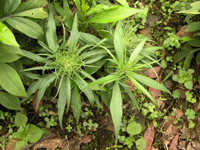
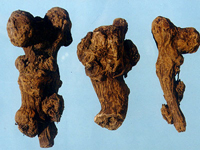
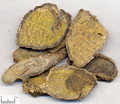
This medicinal is the dried root of Atractylodes macrocephala Koidz(fam. Compositae).The one produced in Yuqian of Zhejing Province is of the best quality and is known as Yuzhu. It is collected in winter. After being baked ordried by natural sunlight and its rootlets removed, it is sliced into thick segments and used in its unprepared form or stir-baked with bran or earth form.
[ Medicinal Properties ]: Sweet, bitter, warm; relate to spleen and stomach meridians.
[ Medicinal Efficacies ]: Invigorate spleen and replenish qi; dry dampness and induce diuresis; stop sweating; prevent abortion.
[ Clinical Applications ]: 1.Spleen qi deficiency syndrome It treats lasstiude, lack of strength, anorexia, loose stool or diarrhea, due to deficiency of spleen qi, in combination with Renshen, Fuling, as in the Sijunzi Decocotion.
2. Edema, phlegm-fluid retention For edema due to spleen deficiency, it is used in combination with Fuling and Zexie; for spleen deficiency with inactivation of middle yang and phlegm-fluid retention, it is used with Guizhi and Fuling, as in the Linggui Zhugan Decoction.
3.Spontaneous sweating due to qi deficiency It may be used by itself or in combination with Huangqi and Fuxiaomai. For qi deficiency with vulnerability to wind pathogens, it is prescribed with Fangfeng, as in the Yupingfeng Powder.
4. Threatened abortion due to spleen deficiency It treats malnutrition of fetus due to spleen deficiency in combination with Renshen and E jiao. For morning sickness, anorexia, heavey sensation in extremities, due to spleen deficiency with interior accumulation of damp turbidity, it is combined with Renshen and Sharen.
[ Usage and Dosage ]:6-12g It is more effective to tonify qi, invigorate spleen and stop diarrhea in its baked form.
[ Precautions ]: It is warm and dry, so it is not recommended for febrile disease with consumption of fluid, as well as yin deficiency with thirst.
[Medicinal Comparison ]: Similarities:Both Baizhu and Cangzhu have the same functions of invigorating spleen and drying dampness.
Differences: Baizhu focuses on invigorating spleen and replenishing qi and treats spleen deficiency with damp harassment, with deficiency as dominant aspect.
Cangzhu ,bitter and warm, functions to dry dampness and treats interior retention of damp turbidity with excess being its dominant aspect. Besides, Baizhu functions to induce diuresis, stop sweating and prevent abortion and treats edema, qi dificiency with spontaneous sweating and spleen deficiency with threatened abortion.Cangzhu also functions to induce sweating to relieve superfiencies, dispel wind-damp and brighten eyes. It treats wind-cold-damp exterior syndrome, wind-damp arthralgia, night blindness and blurry vision with dry eyes.
Similarities:Both Huangqi and Baizhu function to tonify qi, induce diuresis, stop sweating.
Differences: Huangqi, sweet and warm, is stronger in tonifying qi, raising yang and tonifying both spleen and lung, expelling toxin and discharging pus, promoting tissue regeneration and healing wound; therefore, it treats sinking of middle qi manifested as proctoptosis or prolapse of internal organs, deificiency of lung qi as well as deficiency of both qi and blood manifested as chronic ulcers which fail to heal.
Baizhu,being good at invigorating the spleen to dispel dampness, prevents threatened abortion and treats the syndrome of spleen-deficiency with damp harassment and threatened abortion, due to spleen deficiency.
白术为菊科植物白术Atractylodes macrocephala Koidz.的根茎。主产于浙江、湖北、湖南等地。以浙江于潜产者最佳,称为“于术”。冬季采收,烘干或晒干,除去须根,切厚片,生用或土炒、麸炒用。