 Loading... Please wait...
Categories
New Products
-
 $9.99
$9.99
-
 $9.99
$9.99
-
 $199.00
-
 $0.00
$0.00
-
 $129.00
Our Newsletter
- Home
- Formula Herbs Powder(200g/bottle)---中药方剂 (粉剂)
- Yi guan jian(Rehmannia&Ophiopogon Decoction) 一贯煎
- Home
- Formula Herbs Powder(200g/bottle)---中药方剂 (粉剂)
- Tonix Formulae---补益剂
- Yi guan jian(Rehmannia&Ophiopogon Decoction) 一贯煎
- Home
- Formula Herbs Powder(200g/bottle)---中药方剂 (粉剂)
- Tonix Formulae---补益剂
- Formulae for Tonifying Yin---补阴
- Yi guan jian(Rehmannia&Ophiopogon Decoction) 一贯煎


Product Description
【功用】 滋阴疏肝。
【歌诀】 一贯煎中用地黄,沙参杞子麦冬襄,当归川楝水煎服,阴虚肝郁是妙方。
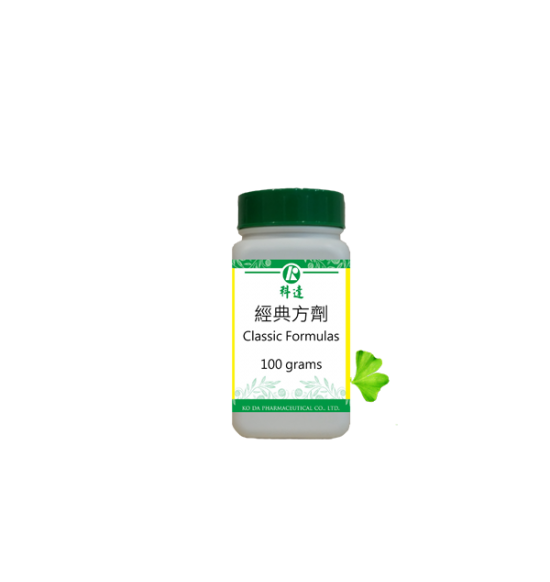
Rehmannia & Ophiopogon powder yi guan jian
[SOURCE]: Liuzhou"s Medical Essays
[INGREDIENTS:]
Glehnia root 9g, Ophiopogon root 9g , Chinese angelica root 9g, Dried rehmannia root 30g , Wolfberry fruit 12g, Sichuan chinaberry 5g
[DIRECTIONS]: Decoct all the above herbs in water for oral administration. EFFECTS: Nourishing yin and soothing the liver.
[INDICATIONS]: Syndrome of qi stagnation due to blood-dryness caused by yin deficiency of both the liver and kidney marked by distending pain in the chest and abdomen, acid regurgitation, dry mouth and throat, red tongue with reduced saliva, thready and feeble, or feeble and taut pulse, hernia, and mass or transient gathering in the abdomen.
[ANALYSIS OF FORMULA]: This is a common formula for stagnation of the liver due to yin deficiency of the liver and kidney. Being the largest in dosage,
dried rehmannia root is the principal herb used to nourish yin and clear heat and it combines with Chinese angelica root and wolfberry fruit in tonifying .yin, nourishing the blood, soothing the liver and replenishing the kidney. Glehnia root and ophiopogon root nourish yin to reduce heat, clear the lung and soothe the liver, and these four herbs are the assistant herbs. Sichuan chinaberry is bitter in flavor and cold in property, and is a adjuvant herb with effect of soothing the liver-qi. The combination of all the herbs in the recipe not only nourishes the liver, but soothes and reguates the liver’s function. The consideration is based on theory of “the liver is characterized by its body pertaining to yin with its function to yang”. This is different from aromatic herbs which are used only to soothe the liver and relieve depression.
In modern clinical practice this formula is used for chronic hepatitis, early stage of cirrhosis, fatty liver, chronic gastritis, gastric ulcer, diabetes, hypertension as well as other chronic disorders attributed to yin deficiency of the liver and kidney.



