 Loading... Please wait...
Categories
New Products
-
 $9.99
$9.99
-
 $9.99
$9.99
-
 $199.00
-
 $0.00
$0.00
-
 $129.00
Our Newsletter
- Home
- Natural Herbs (1 Ib/bag )---天然草药
- Daji (Japanese Thistle Herb)---大蓟


Product Description
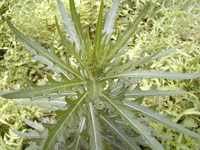
It is the root or the aerial part of Cirsium Japonicum Fish ex DC.,faily Compositae. This medicinal is collected in summer and autumn before the flower blossoms. The root is dug at the end of autumn. Later it is dried in th sun, cut into segments. It can be utilized in the raw or stir-baked form.
[ Medicinal Properties ]: Bitter and cool; relate to heart and liver meridians.
[ Medicinal Efficacies ]: Cool the blood and stop bleeding; eliminate toxic materials to treat carbuncle.
[ Clinical Applications ]: It has the same efficacy and apllication as Xiaoji. When applied to bleeding due to blood heat, or to sore and carbuncle due to toxic heat, they are usually combined with each other. The difference is that Daji's actions of eliminating toxic materials and treating carbuncle are little stronger than those of Xiaoji.
[ Usage and Dosage ]: 9-15g.
[ Precautions ]: Same as that of Xiaoji.
[ Medicinal Comparison ]: Similarties: Xiaoji and Daji have similar functions of cooling the blood, stopping bleeding and eliminatin toxic materials, as well as treating carbuncles. Also bothe treat various types of bleeding, including sores and carbuncles, which are due to toxic heat.
Differences: Daji is slightly stronger in its function to clear toxic heat. Xiaoji has the added function of promoting diuresis, and it is better at treating hematuria and blood stranguria. In addition, Xiaoji is often used to treat bleeding of the uterus and modern research has revealed its ability to shrink the uterus.
大蓟为菊科植物蓟Cirsium japonicum DC.的地上部分或根。全国大部分地区均产。华北地区多用地上部分,华东地区多用地上部分及根,中南及西南地区多用根。夏、秋季花开时割取地上部分,或秋末挖根,除去杂质,晒干,生用或炒炭用。



