Loading... Please wait...
Categories
New Products
-
 $9.99
$9.99
-
 $9.99
$9.99
-
 $199.00
-
 $0.00
$0.00
-
 $129.00
Our Newsletter
- Home
- Single Herbs Powder( 100g/bottle ) ---中药单味(粉剂)
- Tonics---补虚药
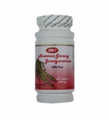
- Xiyangshen (American Ginseng)---西洋参(powder100g/bottle)
- Home
- Single Herbs Powder( 100g/bottle ) ---中药单味(粉剂)
- Tonics---补虚药
- Qi Tonics---补气药
- Xiyangshen (American Ginseng)---西洋参(powder100g/bottle)


Product Description
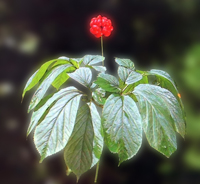
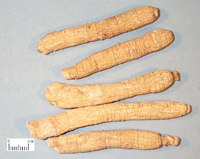
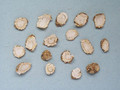
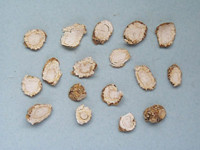
This medicinal is the dried root of Panax puinguefolium L.(Fam. Araliaceae), which is mainly produced in America and Canada and cultivated in China as well. Its roots areexcavated in autumn after the plant has been growing for 3-6years. Then it is sliced and used in its unprocessed form.
[ Medicinal Properties ]: Sweet, slightly bitter, cool; relate to lung, heart and kidney meridians.
[ Medicinal Efficacies ]: Tonify qi and nourish yin; clear heat and promote fluid production.
[ Clinical Applications ]: . 1. Syndrome of both qi and yin deficiency For lassitude, lack of strengthen, shortness of breath, dyspnea, spontaneous sweating with warm and sticky sweat, dysphoria and thirst due to consumption of primordial qi and yin fluid, it is usually used in combinaitn with Maidong, Wuweizi. For palpations, angina pectoris, insomnia and dream-disturbed sleep, it is combined with Gancao and Maidong as well.
2.Lung of qi deficiency syndrome and lung yin deficiency syndrome For shortness of breath, dyspnea, cough with little or bloody sputum, due to the damage to qi and yin of the lung by fire-heat pathogens, it is usually combined with Yuzhu and Maidong.
3. Thirst due to qi deficiency and consumption of fluid in febrile diseases; Xiaoke(similar to diabetes ) In this cases, it is usually used in combination with fresh Shengdihuang, fresh Shihu and Maidong.
[ Usage and Dosage ]: 3-6g, decocted separately. Its decoction is taken orally and used in mixture with other medicinal herbs.
[ Precautions ]: It is recorded in pharmacopoeia that Xiyangshen should not be used in combination with Lilu.
[Medicinal Comparison ]: Similarities: Both Renshen and Xiyangshen have similar funcitons of tonifying primordial qi and are indicated for prostration syndrome manifested as shortness of breath, lassitude, thin and feeble pulse. But the former is more effective for treating prostration syndrome. The latter, bitter and cool, has the added funciton of nourishing yin and is suitable for the treatment of febrile disease with prostration of both qi and yin. Furthemore, both can tonify the spleen qi and lung qi and are used to treat deficiency syndrome of spleen-lung qi.
Differences: Renshen is stronger in tonifying and Xiyangshen is used more in treating deficiency syndrome of both qi and yin of the spleen and lung. Due to their function of tonifying qi and promoting fluid production, both are used to treat consumption of fluid manifested as thirst and Xiaoke(Similar to diabetes). In addition, Renshen has the actions of tonifying heart-kidney qi, inducing tranquilization and improving intelligence and is used to treat insomnia, amnesia, palpitations, fearful throbbing and dyspnea, shortness of breath due to the kidney failure in receiving qi.
西洋参为五加科植物西洋参Panax quinquefolium L.的根。主产于美国、加拿大。我国北京、吉林、辽宁等地亦有栽培。秋季采挖生长3~6年的根,切片生用。